Understanding Nudibranch Behaviour
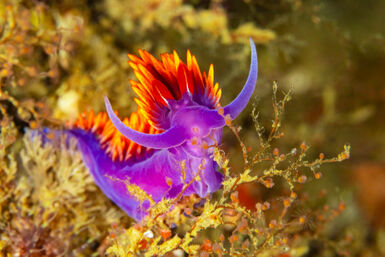
Nudibranchs get their 'sea slug' nickname from more than just their looks, as they move around by crawling along surfaces like a slug, although some species are able to swim for short distances, such as the Spanish dancer. They are solitary creatures and rarely form groups, but when they do, these are temporary and opportunistic moments to hunt more dangerous prey. They have limited eyesight, only able to differentiate between light and dark, and are able to communicate through chemical signals to one another. With over 3,000 species, there's a lot of variety in this animal family; some are born with a shell, some have toxic chemicals, some love the attention and display their patterns to predators, and others mimic their surroundings to hide in plain sight. This diversity and their intriguing behaviours make nudibranchs some of the ocean's most interesting inhabitants.

How and what nudibranch eat
Nudibranchs are carnivorous, but their diet is often highly specific to one type of prey. These little guys slide on their bellies in search of their preferred snack, often munching on sponges, hydroids and anemones. Some, such as the Gymnodoris rubra are cannibalistic and have been seen to eat smaller nudibranchs...
As we've mentioned (and will continue to do so), with thousands of different species, there are many ways that nudibranchs feed and despite their small size, many species can eat hundreds of tiny polyps per day. Typically, they use their rhinophores - the horn-like organs on their heads - to track the smell of their meal, and most species have a set of curved teeth and use a rasping tongue-like organ called a radula to scrape from surfaces and ingest their food.
Others use suction and digestive enzymes to turn their prey into a sort of soup before eating it. The Cratena peregrina enjoys eating hydroids that have just fed on plankton; this way, they are stealing the food inside the prey's belly. Then there's the Melibe, a hooded nudibranch, which traps crustaceans on the sea floor before eating them.
How nudibranchs defend themselves
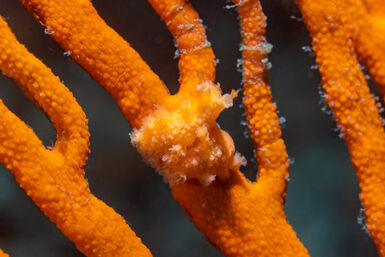
Despite their small size, nudibranchs can put up a fair fight (well, some of them). Known by marine biologists as 'the greatest thieves of the ocean', certain species of nudibranchs will steal stinging cells from prey such as jellyfish and store them in specialised sacs on their bodies for defence. For example, the blue dragon nudibranchs will eat the stinging cells of the Portuguese man o' war and store their stinging cells as ammunition. Other species can acquire and produce their own defensive chemicals from their diet (like sponges) or through de novo synthesis - this is the process of creating complex molecules from simple, basic precursor molecules.
A nudibranch's beautiful colours do more than decorate the ocean; many species use their colours and patterns to deter potential predators, acting as a warning that they are toxic or distasteful. There is an interesting phenomenon called The Ring, which is where mimic nudibranchs will evolve to look like toxic nudibranchs in order to deter predators. The problem is that when too many of the toxic and non-toxic nudibranchs are in the same place, young predators will take a chance, munch on a nudibranch, only to discover that while it may be colourful, it tastes great. Suddenly, both the toxic and non-toxic nudibranchs are under attack, and those toxic ones that can evolve and adapt will do so to differentiate themselves from the mimics. The mimic ones then follow suit, and so The Ring continues…
The colours have yet another defence mechanism; they allow the nudibranchs to camouflage with their surroundings. Some nudibranchs steal their rainbow patterns from the corals that they munch on, and these distinctive hues are then used as camouflage so that they can hide in plain sight from their predators.
Nudibranch reproduction
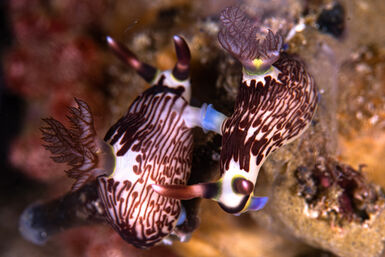
Nudibranchs are rather limited in their pursuit for a mate, given their slow movement, poor eyesight and solitary nature. As a result, it's important that they make the most of any mating opportunity. Nudibranchs are hermaphrodites, meaning that they have both male and female reproductive organs, so they can mate with any adult that passes. Sometimes a process called 'tailing' occurs, which is when nudibranchs who are not yet ready to reproduce bump into each other, but in order not to miss the opportunity to reproduce in the future, one will hang onto the tail of another and follow each other until they are ready to mate - these links can grow to include up to ten nudibranchs!
When they are ready, nudibranchs have a specific courtship ritual which leads to mutual fertilisation and sperm exchange. They mate by lying next to each other and connecting their reproductive organs. In some species, the reproductive organ will snap off during intercourse, but they can grow it back. After mating, both nudibranchs lay eggs, often in a spiral ribbon or cluster shape. Depending on the species, a nudibranch can lay anywhere from a few eggs to millions at a time.
Lifecycle of a nudibranch
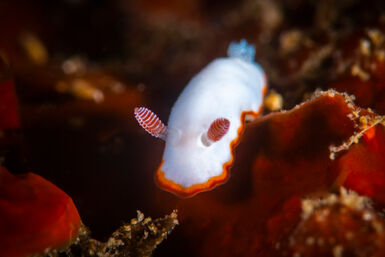
Nudibranchs have short life cycles, most only living up to a year. Once hatched, the young nudibranchs begin their life in the larval stage, called a veliger, which, depending on the species and water temperature, can last from a few weeks to a few months. Some of the larvae have a small shell, which helps them to move through the water to feed on plankton. After some time, once the larvae receive the chemical signals within their environment, they will metamorphose into a nudibranch, shedding their small shell. Some species don't go through the veliger stage and go straight from eggs to an immature adult.
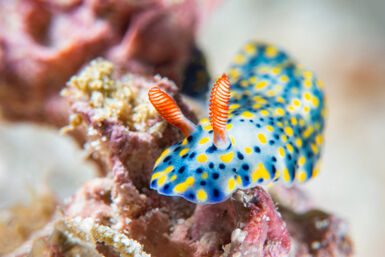
Nudibranchs’ senses
Nudibranchs don't have eyes in the same way that we do. Some species do have 'eyes', but not the complex forms that most other animals have. Rather, their eyes allow them to discern between night and day. Rather than relying on sight, nudibranchs perceive their surroundings using their rhinophores, sensory organs that look like little horns on their heads. With their rhinophores, nudibranchs are able to navigate for food, avoid predators and find mates. They can even sense changes in water pressure and respond quickly to ocean changes caused by pollution, currents and acidification. Their sensitivity has meant that nudibranchs have been helpful players when it comes to tracking changes in the ocean. As they are cold-blooded, their internal temperatures change based on their surroundings. As ocean temperatures rise, scientists have been able to track nudibranchs relocating to cooler water temperatures, as many species have very specific thermal tolerances.