Species of Nudibranch
There are over 3,000 species of nudibranchs, with sizes varying from 15mm, such as the Dotidae family, and others growing up to 40cm, like the Spanish Dancer. Nudibranchs can be found in all bodies of water, and some dive sites will have hundreds of species, so you're almost guaranteed to spot a new colourful creature on each dive. Although bear in mind that they're solitary creatures, so don't expect to see a range of colourful nudis hanging around together.
All nudibranchs sense their way through the water with their two outward-facing nostrils, called rhinophores. Due to nudibranchs' poor eyesight, these rhinophores are extremely helpful to allow the nudis to find mates and food, and navigate the underwater world. Nudibranchs are normally classed into one of two types, characterised by the way they breathe - the aeolid nudibranch and then the dorid nudibranch - and there are 30 different families which categorise them even further.
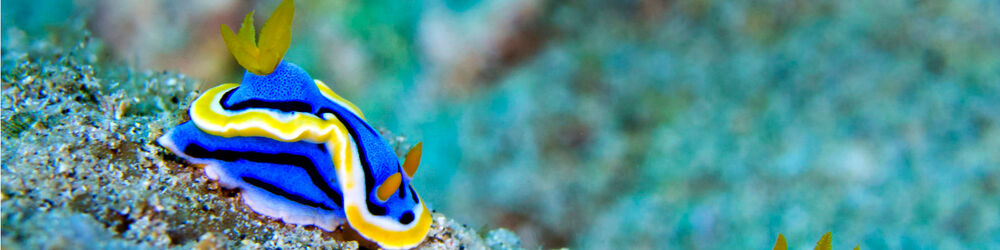
Aeolids
- Breathe by absorbing oxygen through the soft spikes that cover their bodies (known as cerata)
- Suck in their food after pre-digesting its tissues with enzymes
Dorids
- Breathe via a plume of gills (known as branchial plume) around their anus, which are almost feather-like
- They don't have any cerata on their bodies, so are much smoother than aeolids
- Consume food via a beak and tooth-covered tongue they can use to scrape food from rocks
- Are the more common of the two types of nudibranchs
All nudibranchs have predators, and these differ based on where the nudibranch is found and also on its defence mechanism. Some use camouflage, absorbing the colour from the corals that they munch on, others display their bright colours to warn predators that they are toxic (or pretending to be), while others absorb the stinging or toxic cells from their food, such as jellyfish, to act as a defence.
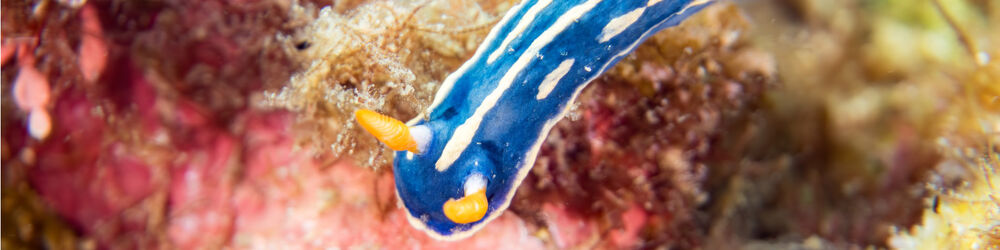
Our Experts’ Favourite Nudibranch Species and Where to See Them
Given there are 30 different families of nudibranchs and over 3,000 species, we can't list them all, but here are a few of our team's favourites to give you a taste of the diversity of this fascinating group...
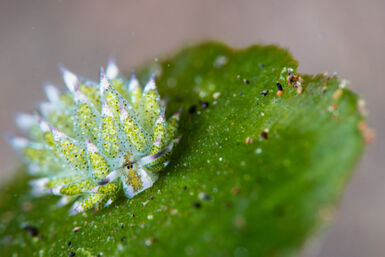
1. Leaf sheep, Costasiella kuroshimae
Beginning with a favourite of ours, the leaf sheep, also affectionately nicknamed 'Shaun the Sheep'. This little cutie can be found next to coral reefs, among the algae that it enjoys munching on. This species has a cool diet: it eats algae and stores its chloroplasts in its own tissues, which it can then use to supplement its diet through photosynthesis.
Average size: from five millimetres to one centimetre
Where to find them: Indonesia (particularly the Lembeh Strait), Philippines (particularly Anilao), Japan.
Defence: Camouflage and toxic absorption from algae.
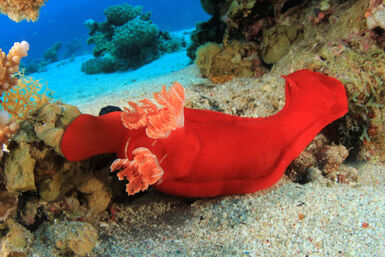
2. Spanish dancer, Hexabranchus sanguineus
The Spanish dancer nudibranch is one of the largest nudibranchs, with its average size measuring between 20 and 30cm, although the largest one recorded reached 60cm! While they mainly crawl along the seabed, these nudi can also swim by undulating their bodies, making them look like a Spanish flamenco dancer's skirt (hence the name). They enjoy eating sponges and can absorb some toxic chemicals to store as their own defence, while their bright red colours do more than make the ocean floor pretty: they warn predators of their toxic abilities.
Average size: between 20 and 60 centimetres
Where to find them: North Sulawesi (Indonesia), Egypt, Australia, Philippines
Defence: Toxic absorption from Halichondria sponges
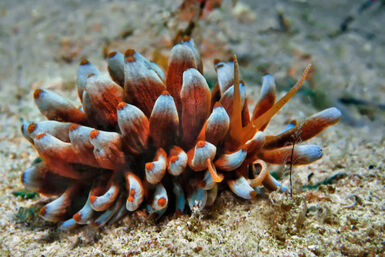
3. Solar-powered nudibranch, Phyllodesmium magnum
The name gives the game away here: this nudibranch can power itself via photosynthesis, thanks to the spikes on its back. Their colourful spikes do more than act as solar panels; they also aid the nudi in respiration, digestion and defence. And how are they so colourful? That comes from the corals and anemones that they enjoy munching on.
Average size: between one and 15 centimetres
Where to find them: Australia, Egypt, the Philippines, Indonesia
Defence: Camouflage and autotomy
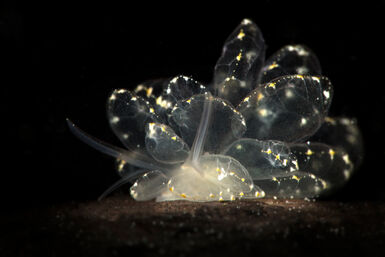
4. Sap-sucking sea slug, Cyerce elegans
An elegant nudibranch indeed, with oval-shaped cerata (horns) decorated with gold or white flecks (think a touch of gold leaf decoration) and a scattering of internal white dots, this nudibranch is the belle of the underwater ball. They can shed its cerata when threatened, distracting the predator while the nudibranch slides the other way. Keep an eye on the algae when diving in the Indo-Pacific as these little beauties are often found here.
Average size: between one and four centimetres
Where to find them: Indonesia, Philippines, Australia, Palau
Defence: Autotomy
5. Rainbow sea slug, Babakina Anadoni
As the name suggests, this rainbow-hued nudi contains most of the colours in the rainbow. These purple, pink and yellow crawlers can puff up their cerata when threatened (in order to appear bigger than they are), and sometimes rear up to scout their surroundings or ward off predators.
Average size: Between two and eight centimetres
Where to find them: France, Spain, the United Kingdom, Portugal
Defence: Autotomy
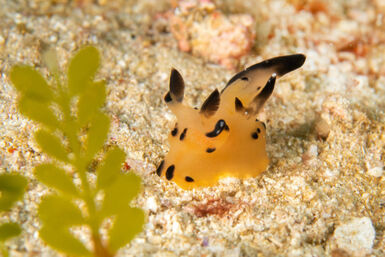
6. Pikachu Nudibranch, Thecacera pacifica
If you're trying to catch them all, then the Pikachu nudibranch is one that has to be at the top of the list. This yellow and black nudibranch is a rare species, found in the muck, most commonly in Tulamben in Bali. Just like the electric jolt that Pikachu can use in the anime, this nudibranch can store the neurotoxin from the jellyfish they munch on, delivering a powerful defence against predators.
Average size: between one and three centimetres
Where to find them: Shallow waters around Indonesia (specifically Bali, Raja Ampat, Lombok and Komodo), the Philippines, Australia, Egypt
Defence: Toxin absorption from their prey
7. Mystery mollusc, Bathydevius caudactylus
The mystery mollusc is one of the newest on the scene. Discovered at an impressive depth of 2,814 meters in the Pacific Ocean, this creature was nicknamed the 'mystery mollusc' due to its unusual appearance. Swimming through the ocean's midnight zone, this nudibranch lights up with bioluminescence and has a hood and a paddle-like tail. This is the first known nudibranch to live in the deep sea and it traps its food using the cavernous hood. They swim through the midnight zone by flexing their bodies, and due to the depth at which they are found, you unfortunately won't be spotting them on a normal dive.
Average size: between five and 14 centimetres
Where to find it: depths of the Pacific Ocean
Defence: Hides in plain sight with its translucent body