
We know the ocean is a fascinating place, but the deep sea is another dimension all together. Beyond depths of 200 metres, sunlight fades and the true deep sea begins. It is here that some seriously strange deep sea creatures survive. Given they roam hundreds of metres below the surface, you won't encounter these alien critters on your dive, as unlike us, they are well attuned to life in the dark depths. Down here, survival is not about looking pretty, it's about adapting, with bioluminescent lures and extraordinairy feeding tactics; when your home is this cold, dark and under immense pressure, evolution gets creative. Feeling intrigued? Read on to discover what creatures lurk below...
Goblin sharks
Goblin sharks are prehistoric deep sea dwellers with a lineage dating back around 125 million years, so they've been doing their thing long before humans ever considered strapping on a tank. Found in the deep waters off the coasts of Japan, Mexico and Portugal, they usually hang out hundreds of metres below the surface. Their party trick is a protrusible jaw, meaning their mouths can shoot forward in a split second to grab unsuspecting prey before snapping neatly back into place. It sounds like a concept for a horror film, but really, it's just an evolved feeding strategy. And if this has you backing away from the shoreline, don't worry - there have been zero recorded goblin shark attacks on humans, as they live far deeper than any diver can reach.
Barreleye fish
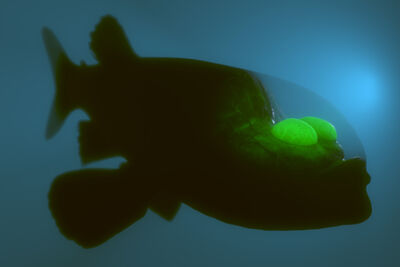
Found at depths of between 600 and 800 metres, barreleye fish sport two upward-pointing orbs visible through transparent domes on their heads. These ultra-sensitive eyes scan the water above, searching for the silhouettes of prey. Adding to their uncanniness, barreleye fish use their flat fins to hover almost motionless in the water, like a silent phantom watching from below.
While you won't encounter this deep-sea oddity on a dive, their relatives offer a taste of barreleye weirdness in shallower waters. Divers in places like Indonesia, Papua New Guinea and the Solomon Islands can spot glassfish, which, as their name suggests, have see-through bodies, and stargazer fish, which bury themselves in the sand and have eyes on the top of their heads, ready to launch a sudden attack on overhead prey.
Vampire squid
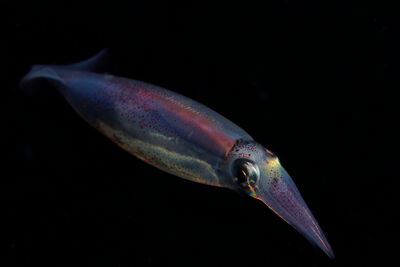
Despite the dramatic name, vampire squid do not, thankfully, suck blood from their prey. Belonging to its own distinct group of cephalopods, this remarkable species is one of the ocean's truly strange deep sea creatures, and are found at depths of 600 to 900 metres, in temperate and tropical oceans all over the world. They survive by eating marine snow, a drifting mix of dead plankton and mucus, making it more of a tidy recycler than a predator. To spot all this microscopic debris, they have enormous eyes, proportionally the largest of any living animal, perfectly acclimatised to finding a snack at the ocean's bottom.
Anglerfish
Anglerfish, one of the ocean's strangest deep sea creatures, are found in the depth of waters off the coast of Iceland, the Caribbean and parts of the Indian Ocean. There are over 200 species, but they all share one iconic feature: a bioluminescent lure called the 'esca', which dangles like a shining fishing rod in front of their faces. Only the females carry this eerie glow, powered by symbiotic bacteria. When it comes to reproduction, the males attach permanently to the females, essentially becoming an in-built helper to ensure the next generation of these predators, much to the despair of their prey. For any poor fish that finally spot their bright light after swimming in total darkness for years, it may end up being the last thing they see…
Lucky for us divers, anglerfish live in the twilight zone of the ocean (200-1,500 metres deep), so we can enjoy our underwater adventures, knowing that they are somewhere far, far below.
Giant isopods
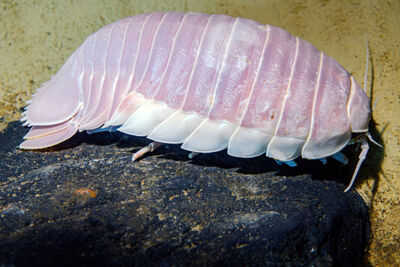
Imagine an aquatic woodlouse almost one and a half feet long - that's the giant isopod, a benthopelagic scavenger found on the ocean floor, in places like the Bahamas and Australia. These crustaceans live a pretty bleak existence, wandering the seabed and waiting for something edible to fall from above, thanks to a slow metabolism that lets them go months without a meal. Despite this meagre diet, they've inherited the deep-sea giantism phenomenon, growing far larger than their shallow-water cousins. Scientists think it's because bigger animals are more efficient in resource-scarce depths.
Take a dive in the waters off Madagascar, Mozambique or Tanzania to see their smaller cousins, marine isopods, everywhere. When you spot them, imagine what they'd look like ten times bigger...
Sea angels
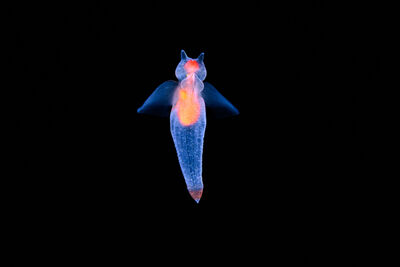
Names can be deceiving, and the sea angel certainly is. A type of swimming snail, these predators hunt sea butterflies and other small organisms, fluttering through the water with winged fins. When it's time to feed, sea angels push out finger-like tentacles from their heads to snatch their catch, making them one of the ocean's most bizarre deep sea creatures. And with more than 80% of the ocean still unexplored, who knows what other bizarre life forms might be lurking in the depths?


