
Certified coastal cruisers, blacktip sharks can be found in warm waters and coral reefs around the world, from the remote Galapagos archipelago to the sun-drenched Persian Gulf. These stout-bodied, energetic creatures are also no strangers to sharing the water with humans, but often don't approach, preferring to keep their cards close to their fins. Keen to take a deep dive (sorry) into the talents and traits of these coy carnivores? Read on for our top ten blacktip shark facts...

1. Blacktip sharks are not blacktip reef sharks
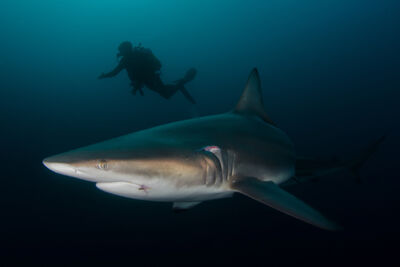
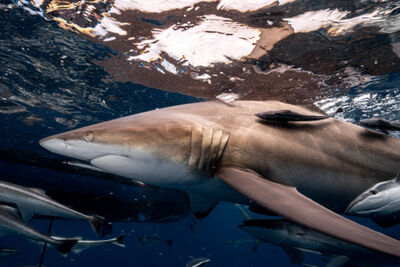
Thanks to their incredibly similar names - and appearances - blacktip sharks and blacktip reef sharks are ripe for a case of mistaken identity. Despite this, they're actually two entirely different species of shark. The key to deciphering who's who during a dive: look out for a black marking on the dorsal fin, as only blacktip reef sharks have this.
2. They can also be confused with spinner sharks
While names aren't the issue here, blacktip sharks can also be confused with spinner sharks. This is because they look alike and share an affinity for spinning through the air while feeding on schooling fish (more on that later). Once again, markings come to the rescue when trying to tell the two apart - while blacktip sharks have white anal fins, spinner sharks (somewhat confusingly) have black-tipped ones.
3. Vision is not their only source of navigation
Now that we've clarified who exactly we're dealing with, it's time to delve into their talents and traits. To start, blacktip sharks boast excellent navigation skills. Researchers found that, when returning home at night in tannin-stained, opaque water, blacktip sharks were unfazed, which suggests they were relying on something other than vision to guide them.
4. Hearing is another strong suit
Since ears aren't a prominent feature on sharks, it's easy to overlook their sense of hearing. But make no mistake blacktip sharks are expertly tuned in. In fact, a 2026 study found they could hear sounds played underwater from at least 74 metres away. Interestingly, when the sharks detected these noises, they turned away rather than swimming towards them - safe to say they value their peace and quiet.

5. Their sense of smell is stellar too
Rounding out this trifecta of top-tier talents, blacktips are also quite the sniffer dogs - well, sharks. In a study that displaced the sharks about five miles from their homes, researchers found that those with their sense of smell blocked took considerably longer to return home. And here's a bonus fact: two-thirds of the brains of all sharks, not just those of blacktip sharks, are dedicated to smell.
6. More than 100,000 blacktips were counted in aerial surveys
Blacktip sharks can be found worldwide, from the warm waters off the coast of Japan's Ryukyu Islands to the cooler climes around Cape Cod in Massachusetts during summer. They've also been known to gather in large numbers. In fact, in southeastern Florida alone, researchers conducting ariel surveys counted (very precisely) 104,255 blacktip sharks.

7. Feeding doesn't only take place underwater
Blacktip sharks might live underwater, but that doesn't mean they limit themselves to this domain when feeding. As mentioned above, these not-so-distinctly marked predators have a penchant for spinning, rotating several times as they launch out of the water to catch bony fish near the surface (yes, really). It's a practice known as 'breaching', and it's part of the shark's rather cunning - not to mention extravagant - hunting method.
8. Blacktip sharks are not fussy eaters
While bony fish are a big part of their diet, blacktip sharks have also been known to eat smaller sharks, skates, rays, squid, shrimp and crabs. It's a buffet-style approach to the ocean, and one that pretty much ensures they'll never go hungry. Who could blame them?
9. A sudden cold front can send the youngsters packing
Juvenile blacktip sharks don't always wait for permission from mum to leave the nursery (classic teen behaviour). Instead, they're sometimes influenced by changes in water temperature. Sudden temperature drops of as little as 5°C, caused by cold fronts, have been known to make youngsters flee the nest - or, you know, escape the reef.
10. It's not all juvenile jitters, though
While cold fronts have been enough to send some juvenile blacktip sharks running for the hills (by which we mean higher ground corals), others stay in the same bay for nearly two years. In one 2026 study, researchers tracking a group of 29 juveniles in Hawaii discovered they were present in a single bay year-round, with one juvenile staying for a whopping 598 days. Talk about failure to launch - until they get peckish, of course…


