
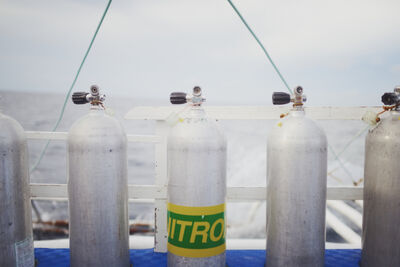
Ever wondered what those dive tanks with strange green and yellow stickers on them are? These tanks contain 'voodoo gas' - the nickname given to nitrox when it first began to appear on dive boats back in the 1980s. We're here to answer some common questions about nitrox, so you can impress with your knowledge the next time you're on a dive boat. These days, the average diver is a lot less sceptical about nitrox diving, and the nitrox certification course is by far PADI's most popular Specialty Diver Course. Contrary to old superstitions, there's no black magic involved in nitrox diving, just a bit of basic physics to get your head around and a few extra steps in dive planning. So, let's take a closer look at what recreational nitrox diving is, and why you may want to earn a nitrox certification on your next luxurious dive holiday…
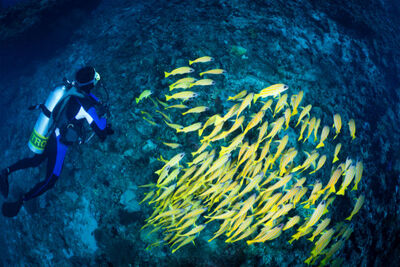
What is nitrox diving?
Technically, nitrox is any gas mixture composed of nitrogen and oxygen (with trace gases being ignored). For recreational divers, the term usually refers to gas mixtures that contain between 22% and 40% oxygen - this is why nitrox is sometimes called enriched air. To increase the percentage of oxygen in the mix, some nitrogen has to be sacrificed. Having more oxygen and less nitrogen in your dive tank has consequences which need to be fully understood before you can dive safely on nitrox.
Less nitrogen in a recreational nitrox mix means that you can have longer no-decompression limits (NDLs). We learn in the Open Water Diver Course that nitrogen is one of the limiting factors when it comes to how long we can spend underwater, so if there's less nitrogen in the tank, we'll be breathing less in with each breath. So, if two divers are at the same depth, one on air and one on nitrox, the nitrox diver will take in less nitrogen, meaning they could stay at that depth for longer before needing to do decompression stops at the end of the dive.
However, having more oxygen in the tank when nitrox diving introduces another potential problem. Under elevated pressure, oxygen becomes toxic. When diving with air (21% oxygen), a diver would need to go deeper than 55 metres (which is well past recreational limits) before the amount of oxygen in each breath would become toxic. However, with nitrox, there's a higher amount of oxygen in the tank, and it will become toxic at much shallower depths. The maximum operating depth (MOD) of a dive tank containing 36% oxygen would be a little shallower than 30 metres, which is within recreational depth limits (phew).
What are the benefits of earning a nitrox certification?
The main benefit of nitrox diving is having extended NDLs for the same depth when compared with air diving. For example, Malapascua in the Philippines is well known among divers as the world's best location to dive with the elusive thresher shark. These deep-water sharks have sensitive eyes that allow them to see in the darkness of the deep, but they still need to visit cleaning stations in shallower water. At first light (before the sun gets too bright), the sharks will swim up to the cleaning stations on Monad Shoal for their morning ablutions.
Monad Shoal is a flat sunken island, and there is little opportunity to shallow up at the end of your dive. Typically, divers will descend to around 24 metres and wait at the cleaning stations until they get close to their NDLs. For those diving on air, this comes along too quickly for some, and they may miss the sharks. For nitrox divers, however, the NDLs can almost be doubled. This means you'll have twice the chance of starting your day with the hypnotic sight of the long-tailed-threshers.
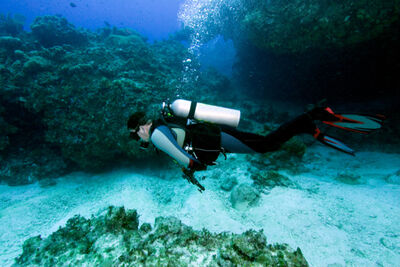
Can you dive deeper on nitrox?
This is perhaps the most common misconception about nitrox diving. As mentioned above, the increase in the percentage of oxygen in a nitrox tank compared with an air tank can lead to issues with oxygen toxicity. In a nutshell, the higher the percentage of oxygen in your tank, the shallower you must stay on your dive.
What nitrox enables you to do is to extend your NDLs for a given depth compared with air diving at the same depth. For example, the Iro Maru wreck in Palau lies with its deck at around 25 metres deep. Air divers can cruise around the decks and can even slip down the sides of the ship to see the torpedo damage that sank it. However, their NDL will be around 35 minutes or shorter if they venture a little deeper than the deck. If you took a tank of nitrox 32, your NDL would increase to around 50 minutes, and with nitrox 36, it would be a fraction over an hour. However, nitrox 32 becomes toxic at around 33 metres and nitrox 36 at around 28 metres, so nitrox divers would be advised to stay on the deck to stay safe and avoid oxygen toxicity.
Can you dive longer on nitrox?
Theoretically, yes, but in reality, only maybe. Another nitrox diving misconception is that nitrox allows you to dive for longer periods of time. While nitrox does increase divers' NDLs, it doesn't magically improve their air consumption.
Increased no-decompression limits mean that you can stay longer at a given depth than an air diver could, but staying longer at depths in the 20-30 metre range means you have to keep a closer eye on your gauges. The Open Water Course teaches you that your air supply lasts less time at depth than when in the shallows, and that principle still holds true when nitrox diving. If you have a smaller lung volume, you may enjoy the benefits of extended NDLs, but if you have very large lungs, you may notice that before you've reached your NDL, you need to start heading up as your gas supply is getting low.
Do you need special equipment for nitrox diving?
These days, most dive equipment is made with recreational nitrox use in mind. Recreational divers use nitrox with a maximum oxygen content of 40%, and at these percentages, there's usually no issue (although you should still check the manufacturer's guidelines). Technical divers who use higher percentages of oxygen (including 100% oxygen in the shallows) need to be more careful in their equipment choices.
If you're thinking about earning a nitrox certification, a nitrox-compatible dive computer would be a wise investment (unless you already have one, of course). During the nitrox course, you'll learn how to use your computer to safely plan and execute dives with nitrox.
When should I dive on nitrox?
You'll get the most benefits from nitrox for dives between 20 and 30 metres, as long as you have decent air consumption rates. As mentioned above, nitrox is ideal for dive sites where you want to spend the majority of your time in the 20-30 metre depth range, for example, a flat profile on a 25-metre deep wreck or waiting at deep cleaning stations.
Planning an intense diving schedule? Nitrox might be a good idea - in fact, many liveaboards and some resorts offer free nitrox to guests who already hold a nitrox certification. If you plan on doing four or five dives each day, as is typical on a liveaboard, then you may want to opt for nitrox. Taking in less nitrogen on each dive can give you more freedom, especially on the last two dives of the day. It can also help you avoid decompression sickness.
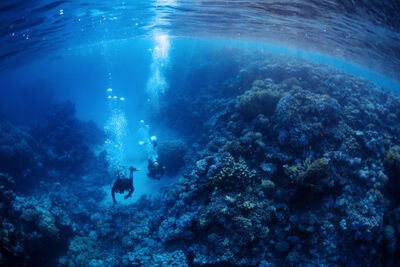
How to get a nitrox certification?
While the Enriched Air (Nitrox) Diver Specialty Course is PADI's most popular specialty, it's also one of the easiest and most convenient to take. You don't even have to dive! Everything you need to know to dive safely with nitrox can be learnt on land.
The course involves a combination of bookwork (or eLearning) for the theory, a video (built into the eLearning), a multiple-choice exam, and a couple of practical sessions. The practical sessions teach you how to analyse a nitrox tank to ascertain its oxygen content and how to plan dives with your dive computer.
While you can easily earn this certification on holiday, you could also get your nitrox certification before jetting off to paradise. That way, you won't have to forfeit any precious beach time or brace yourself for the cooler waters of home…


