
Manta rays are some of the most charismatic and beautiful creatures that inhabit our oceans. Together with devil rays, manta rays are collectively known as mobulids, and are closely related to sharks and other rays. While cartilaginous like their cousins (meaning they have a skeleton made of cartilage), they are true filter feeders and must stay in perpetual motion to keep water moving over their gills, allowing them to breath. They can be found throughout tropical and sub-tropical regions, but despite being so widespread, there is only one decade of scientific study that surrounds them, which means much of their life histories remain a mystery.
In 2009, scientists established two distinct species of manta ray; the reef manta (Mobula alfredi) and the giant oceanic manta (Mobula birostris), but an exciting development from a study published in July 2025 meant that a third species has now been identified - the Atlantic manta ray (Mobula yarae). Read on for our rundown of the different species of manta ray…
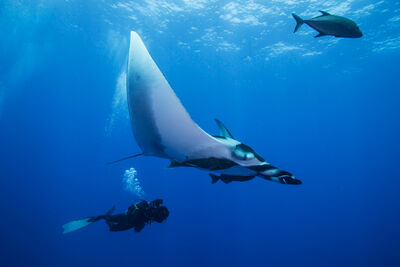
1. Reef manta (Mobula alfredi)
The reef manta is the smallest described species of manta ray, with a disc width of 115-140 inches (maximum 170 inches), maximum weight of 132 stone and an approximate lifespan of 40 years. Reef mantas are widely distributed throughout the Indian and West Pacific Oceans, in both tropical and sub-tropical regions. They can be found anywhere from the Great Barrier Reef and Ningaloo Reef in Australia, to Indonesia, Papua New Guinea, Yap (in Micronesia), the Maldives and even the Red Sea.
Reef mantas are the species most commonly encountered by divers and snorkellers, as they tend to frequent shallow, coastal reef waters where they can be seen in feeding 'frenzies'. During a frenzy, multiple mantas may swim in circles or form chains, all feeding together in a coordinated manner. If you're lucky, you may even witness them mating, when as many as thirty males line up behind a female.
Key ID features:
- The transition between the white and black markings on the dorsal surface is blurred, forming a 'V' in black
- If present, ventral spots are found between gill slits and across the edge of the pectoral fins and abdomen
- Their tail is equal to or shorter than their disc width
- They have large gill plates. Plates are coloured uniformly black, although occasionally they are completely white

2. Giant oceanic manta (Mobula birostris)
The giant oceanic manta claims its name for good reason! It is the largest manta ray species in the world, with a disc width averaging 160-200 inches, reaching a maximum width of 270 inches in larger specimens. They can weigh up to 315 stone and live for 40 years, as with the other manta species.
Oceanic manta rays are widely distributed throughout tropical and subtropical regions; overlapping with reef mantas across most of their range. Places like the Maldives, Baja California and Socorro Island in Mexico, Fiji, Yap and Indonesia are all home to oceanic mantas. Despite this wide range, they are under threat, due to the demand for their gill plates from targeted fisheries. In addition, their reliance on zooplankton as prey is beginning to impact their population, as the effects of climate change are limiting the abundance of zooplankton in the oceans.
As their name suggests, oceanic mantas spend much of their time in open ocean, away from reefs. They will dive to depths of hundreds of meters in order to seek prey and generally spend much less time visiting reef cleaning stations - unlike their reef manta cousins. For this reason, encountering an oceanic manta around a reef is incredibly rare, though not unheard of! If you want sightings of oceanic mantas, it's best to go somewhere they are regularly found like Socorro Island in Mexico or the Galapagos Islands in Ecuador (peak season is December to May).
Key ID features:
- Their dorsal white shoulder markings form two mirror image right-angled triangles, creating a 'T' in black
- If present, ventral spots are clustered around the lower abdominal region
- The inside of their mouths, their cephalic fins and the trailing underside edge of their pectoral fins are usually shaded black (excluding leucistic morph)
- They have a knob-like bulge housing their vestigial spine at the base of the tail
- They have large gill plates with fused lateral lobes and a rounded terminal lobe. Plates are coloured uniformly black, although are occasionally completely white
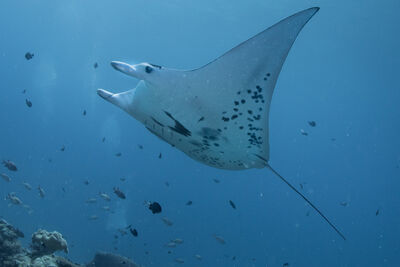
Atlantic manta ray (Mobula yarae)
The Atlantic manta is the newest described species of manta ray, only discovered in 2025. They can reach up to 170 stone, have a disc width of 115-160 inches (with a maximum 190 inches) and their lifespan is likely to be around 40 years, much like other species. They can be found throughout the Caribbean (such as in Grenada and the Bahamas), around the Caribbean coast of Mexico, and along the Atlantic coastline of the Americas (including Florida and Brazil).
Atlantic mantas occupy similar niches to reef mantas, using inshore reef areas to access plentiful supplies of food. It is thought that it may have been pioneering oceanic mantas that crossed open ocean towards the Caribbean who then diverged to form the Atlantic mantas.
Key ID features:
- Their dorsal white shoulder markings form two mirror image right-angled triangles, creating a 'T' in black
- This 'T' shape tapers together towards the bottom where it joins the back
- If present, ventral spots are clustered around the lower abdominal region
- They often have large patches of round or oblong shaded areas on the belly below the gills


