
When you begin your scuba diving journey, you'll likely hear diving terms that sound like a completely different language. But don't worry, we have you covered. Some of this lingo is essential for safety, while other phrases refer to key skills every diver should know. One thing's for sure: divers are partial to acronyms and abbreviations. That's why we've put together a handy cheat sheet to help you dive straight into the world of scuba speak. Keen to know more? Read on to become dive-lingual…
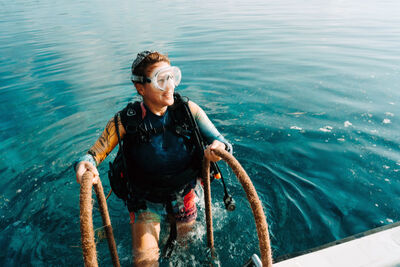
Dive kit essentials
First, let's talk equipment. When it comes to scuba diving terms, knowing what your kit is called is crucial to ensuring a safe and smooth diving experience - after all, it's what you'll be relying on every time you venture underwater.
Fins
Often mistaken for flippers, diving fins are worn on your feet to help you propel through the water easily. Nail this, and you'll be speaking the language of divers from day one. Fins come in many designs and can be full-foot fins (worn over your foot with nothing else) or open-heel fins, which are worn with a boot on your foot first.
Mask
Not to be confused with goggles, a diving mask also covers your nose. It lets you see underwater and breathe through your regulator. Are you a glasses wearer? Stick with contact lenses or use a prescription mask and you're good to go.
BCD / BC / Jacket
BCD stands for buoyancy control device. It does exactly what it says on the tin: allows you to control and maintain your buoyancy underwater by adding or releasing air. Your BCD also holds your tank securely in place and you'll quickly become familiar with it during your Open Water course.
Regulators / Regs
These are the set of hoses that attach to your tank via a first stage, either DIN or yoke. The first stage reduces the high-pressure air in your tank to a breathable pressure and delivers it to your second stage (the part you breathe from). A separate inflator hose also connects to your BCD, allowing you to control the air inside.
Octopus / Octo / Alternate
Not to be confused with the eight-armed cephalopod, an octopus is your alternate air source and makes up part of your regulators. Often shortened to 'Octo', it's used for emergency situations when a buddy needs to share air or if something goes wrong with your main regulator.
SPG / Pressure gauge
Submersible pressure gauges let you check how much air you have left in your scuba tank. Usually part of your regulator set, they provide real-time readings about your air supply, so you can end your dive safely.
O-Ring
This is a small rubber doughnut-shaped circle that creates a seal between parts. It helps keep air or water from escaping or entering your gear. You'll find one at the top of your tank, inside parts of your regulators and even in underwater cameras.
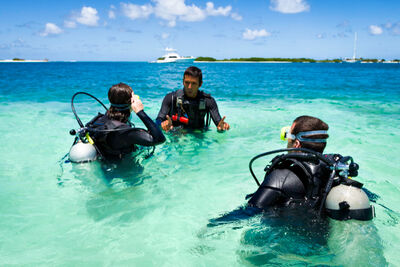
Safety first
Safety is everything in scuba, and these diving terms will crop up regularly, so it's worth familiarising yourself with them before you hit the water.
Surface interval
This is the time you spend on the surface between dives and typically lasts around one hour. It gives your body time to return nitrogen levels to normal before your next dive. This term will be applicable to any day where you're doing more than one dive.
Off-gassing
Off-gassing involves slow ascents, staying within your dive limits and taking proper surface breaks. When you dive, your body absorbs nitrogen into your tissues. If you ascend too quickly or skip those surface intervals, nitrogen bubbles can form, which is why off-gassing is so important.
Safety stop
Divers make safety stops at the end of every recreational dive in order to 'off-gas' some of the nitrogen their tissues will have absorbed during the dive. They pause at around five metres for three minutes. Being a little deeper than the surface actually helps speed up the process.
DCS / Decompression sickness / 'the bends'
Decompression sickness is a medical condition that occurs when nitrogen bubbles form in the body after a diver ascends too quickly or lingers too long at depth. You may know it as 'the bends', a nickname that comes from the joint pain it can bring on, sometimes causing divers to 'bend' or hunch in discomfort.
No-fly time
No-fly time is exactly what it sounds like: the recommended timeframe before you hop on a plane. This helps to reduce the risk of decompression sickness. The usual advice is to wait at least 12 hours after one dive and 18 hours after two or more. You should always follow your own dive computer, and if you want to be extra cautious, some divers leave a full 24 hours before their next flight.
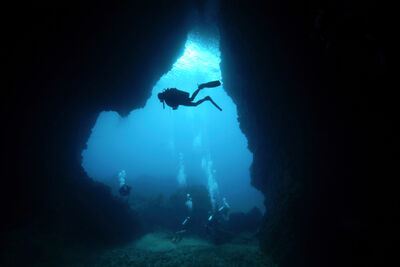
Diving skills
You may hear these terms during your dive briefings, as your instructor walks you through the plan for each dive.
Backroll entry
As cool as it sounds, the backroll entry is where you enter the water from the side of a boat (usually a small one) back first. It's a key skill to learn as many dives take place from small or inflatable boats.
Giant stride entry
A giant stride entry is the other way to enter the water, usually from larger boats with a platform at the back or straight off a dock. From an upright standing position, you take one confident, oversized stride out into the blue. It's the last step (literally) before your diving adventure begins.
Buoyancy
This refers to your position in the water when diving. You should aim to be neutrally buoyant, floating effortlessly in the middle of the water column. If you're negatively buoyant, you're sinking in the water and are over-weighted. If you're positively buoyant, you're floating upwards and you should use more weight or deflate your BCD.
Hover
Hovering is achieved when you're neutrally buoyant. It can be tricky to master at first, but good buoyancy control is vital for a safe, smooth and enjoyable dive.
Trim
This is your position in the water and how streamlined you are. Having good trim means you're also neutrally buoyant, arms tucked in and all your gear (gauges and hoses) are neatly tucked close to your body, not dragging on the reef.
Equalising
As you dive deeper, you'll notice that the pressure changes squeeze the air spaces in your body - your ears, sinuses and even your mask. To counter this, gently pinch your nose and blow to equalise the pressure in your ears and sinuses. To prevent your mask from pinching, exhale through your nose into your mask.
Really dive into the lingo
If you're ready to take your skills to the next level, learning these diving terms might help you connect with fellow divers on your next trip as you navigate the underwater world with ease.
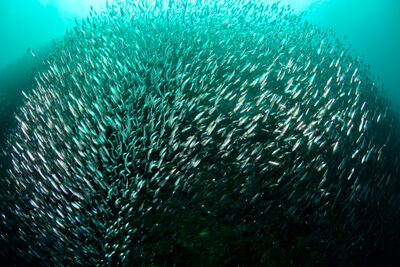
Bait ball
This refers to a large school of fish that groups together to protect itself from predators. It's an amazing spectacle to witness and common in diving hotspots like Baja California, Mexico and Moalboal in the Philippines.
Thermocline
A Thermocline is a layer where warmer surface water meets cooler water below. This sudden temperature change can make the water feel much colder and create a hazy effect underwater.
Liveaboard
Think of liveaboards as your floating dive base. These boats - from sleek yachts to traditional phinisi - accommodate divers overnight and are equipped with cabins, bathrooms, dining and social areas, and plenty of storage. They're ideal for reaching remote spots, like the Galapagos, Socorro or Cocos Island, or for destinations where you can dive several times a day - think the Banda Sea, Palau or Fiji.


