
What if you could anticipate the occurrence of a natural phenomenon? And no, we're not talking about clairvoyancy. Fish spawning (a mesmerising marine reproductive event) takes place in alignment with the lunar cycle, meaning they can be anticipated, and planned for, months in advance. This gives divers in the know the chance to encounter hundreds, often thousands, of fish as they gather to mate, fight and - for the unlucky few - be preyed upon by wily observers. Intrigued? Read on for our guide to fish spawning in Palau...
What is a spawning event?
Before we delve into the fins and frills of spawning dives, it's worth explaining what these events actually entail. Fish spawning is the most common of a variety of ways that fish can reproduce - some of the others being asexual reproduction (whereby fish change sex or possess both male and female reproductive organs) and internal fertilisation (which involves live births, not unlike those seen in mammals).
During spawning, male and female fish congregate in the water column to engage in a synchronised release of sperm and planktonic eggs (microscopic organisms that drift in the sea). A few days later, these eggs hatch into larvae, which then take anywhere from another few weeks to another few months to develop into juveniles.
What makes it so exciting?
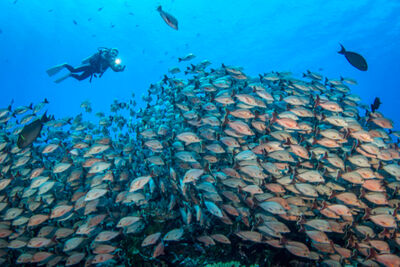
Since these events draw such large numbers of fish to one area, they're a gloriously grand spectacle to behold. To start, fish gather from every direction, growing in numbers and excitement as the water becomes dense with life. Then, the spawning begins, and a captivating choreography unfolds, with the plentiful participants swimming around one another in a menagerie of movement that's nothing short of spellbinding.
Another reason to get excited about these events is the fact that they're lunar-led (synced to the moon's phases), meaning they can be anticipated, and planned for, months in advance. The local guides and skippers we work with have also become particularly skilled at predicting the exact time and place these events take place, so here at Original Diving, we can practically guarantee you won't miss out.
Bumphead parrotfish spawning
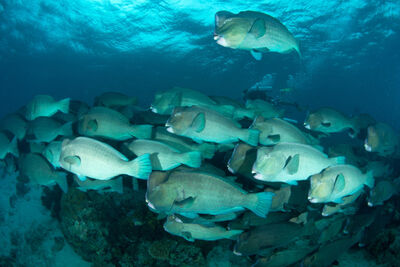
In shallow reef sites, as the sun rises, bumphead parrotfish gather by the hundreds (sometimes even thousands) to prepare for a spawning session. This fish species is aptly named as males do indeed bump heads to assert dominance during the escalating frenzy - an aquatic acoustic that's bound to add to the adrenaline rush. These spawning sessions tend to last 30-45 minutes and take place every morning over the span of a few days.
To be able to participate in a bumphead parrotfish spawning dive, you'll need to have been on at least 100 dives beforehand and have good air consumption. This is not only due to the sheer scale of fish, but also due to the notoriously strong currents that sweep through Palau.
Red snapper spawning
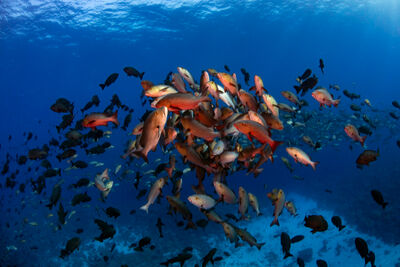
Another group of early risers, red snappers also congregate at dawn. However, their spawning sessions draw crowds of anywhere from 5,000 to 10,000 fish. Even more exciting: parades of predators tend to patrol the perimeters of these huge aggregations, meaning you'll be able to observe bull sharks and blacktips as they slyly spring at distracted fish. Although red snappers are smaller in scale than their headbutting counterparts, the impressive nature of their numbers makes a compelling argument for quantity over quality, making their hour-long spawning sessions just as - if not more - worthy of the pilgrimage to Palau.
To be able to participate in a red snapper spawning dive, you need to have been on at least 100 dives and have good air consumption. PADI AOW with Nitrox is also ideal, and, due to the tight timings these dives necessitate, you'll need to be an early bird (or, at the very least, you'll need to be able to cosplay as one for a few days).
Why Palau?
Now that we've covered the specifics and showmanship of spawning, it's time to address the elephant (or should we say fish?) in the room. Both bumphead wrasse and red snappers are native to large swathes of the ocean, so why is it preferable to see them in Palau?
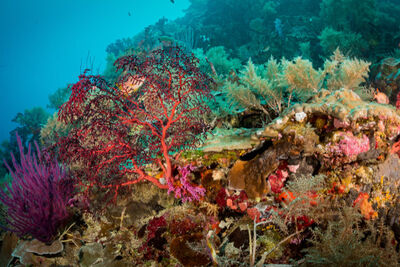
The answer is simple: Palau is a premier dive destination. Located in Micronesia, the country is renowned for its healthy and abundant coral reefs, which routinely and reliably host spectacular spawning sessions. On top of this, the area is also a jewel of conservation, boasting protected waters, shark sanctuaries and no-take zones. For a chance to witness this miracle of marine reproduction at its most extravagant, Palau is the place to be.
If our guide to fish spawning in Palau has piqued your interest, why not dive (sorry) into one of our sample itineraries?


