Growing up is a time of change and uncertainty for most of us, but for certain fish, it also entails a complete physical transformation. From the classic elongation of bodies to the more peculiar donning of eye masks (only in pattern form, sadly), there's no shortage of weird and whacky ways fish can shed their adolescent appearance. But why do these marine makeovers take place, and where can you hope to glimpse these drastically different generations on your dives? Read on for our five favourite fish that transform from juveniles to adults...
Zebra Sharks
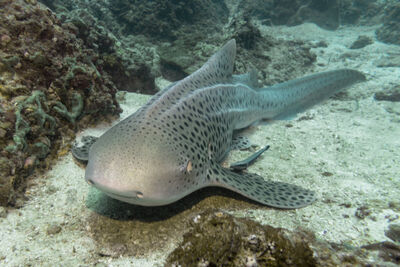
Starting with a fish whose physical changes from juveniles to adults are so severe, they end up rendering its name utterly useless. Young zebra sharks flaunt high contrast black and white striping to deter predators, mimicking venomous banded sea snakes and (inadvertently) zebras. However, when fully grown, they are instead identified by a series of spots, not stripes. They have long, sleek bodies that, combined with their spotted skin, camouflage them against the reef floor. It's fair to say that these fish are far more befitting of their name as juveniles…
Where to find them
Technically, these calm, bottom-dwelling fish can be found throughout the Indo-Pacific, from the Red Sea and East Africa to Southeast Asia. However, since they're listed as endangered by the IUCN, they're hard to find. Your best bet is in Australian waters, where zebra sharks don't possess an endangered status. These ill-named rarities are most often encountered resting on sandy seabeds or cruising through shallow reefs, lagoons and coral gardens.
Harlequin Sweetlips
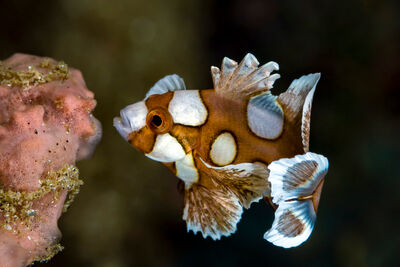
Juvenile showboats, harlequin sweetlips start out life with a distinctly dramatic appearance. Shades of orange and tan dominate their bodies, complemented by large white spots traced in black, with fluttering fins. However, in a tale as old as time, these fish shed their youthful extravagance for a more refined appearance as they approach adulthood. Once fully grown, they no longer need to deter predators with their arresting appearance and quick movements. Sadly for sweetlips, this also means their vibrant bodies fade to a muted grey, adopting a tighter constellation of dark brown spots as opposed to the playful polka-dots of their youth.
Where to find them
Harlequin sweetlips occupy a vast expanse of water, from the Red Sea and East Africa to Southeast Asia, the Great Barrier Reef and the western Pacific Islands. A favourite among photographers, juveniles prefer sheltered lagoons and shallow coral heads, while demure adults can often be seen moving slowly in small, relaxed groups along reef slopes and drop-offs.
Pinnate Batfish
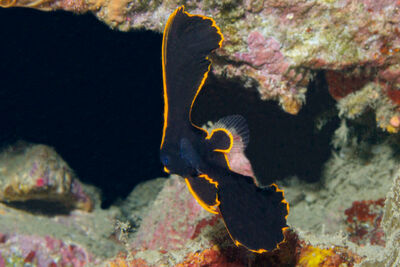
Another stunning shapeshifter, pinnate batfish undergo a comprehensive change from juveniles to adults. In their youth, they have a startling look, defined by a jet-black body and a bright orange outline. Paired with scalloped fins and slow fluttering movements, this exterior mimics that of the highly toxic flatworm - the ideal deterrent for determined predators. However, as pinnate batfish mature, they adopt an entirely new shape, filling out into a disc-form, and trading their gothic getup for pale silver skin with vertical black bars.
Where to find them
As juveniles, pinnate batfish are a solitary species, often hiding in caves, mangroves and overhangs, as well as the cracks and crevices of coral reefs. Whereas in adulthood, they tend to gravitate towards reef walls, wrecks and sheltered bays, hovering in loose schools or gliding gently through calm currents at depths of around 20m. These fish can be found from the waters of Southeast Asia to those around the islands of the western Pacific.
Emperor Angelfish
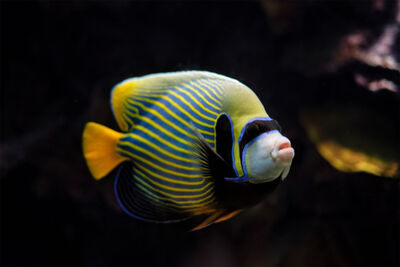
Emperor angelfish are equipped with a series of concentric rings of electric blue and pristine white in their youth, resulting in a mesmerising mien. With age, a metamorphosis takes place, transforming these captivating creatures into equally spectacular adults. Once fully grown, they boast bold horizontal stripes of blue and yellow, and (best of all) a distinctive black eye mask. This mask, or stripe if we're being technical, is intended to confuse predators - it certainly adds a mean edge.
Where to find them
So, where can you hope to see emperor angelfish? They're native to the Indo-Pacific, occupying waters from the Red Sea and East Africa to Hawaii, New Caledonia and southern Japan. Juveniles favour sheltered crevices and lagoonal coral heads, while their mature counterparts prefer patrolling reef slopes, coral gardens and drop-offs.
Smooth Trunkfish
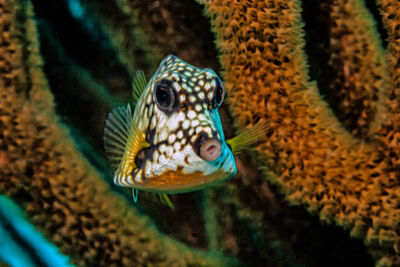
Last on our list of our five favourite fish that change from juveniles to adults is the smooth trunkfish. Lovingly dubbed 'sea peas' in their infancy, these fish are delightfully distinctive, characterised by a spherical black body and pale-yellow dots. The result is cartoonish, making them instantly recognisable. With time, they lose this rotund shape, becoming triangular and bulky, a pair of bulging lips and a snout forming one of their points. Colour-wise, they soften up, swapping a black body for a dark brown one and their dots for a series of tiny white spots. Their fins receive an upgrade too, becoming longer and more feathery - similar to brushes.
Where to find them
Often found in the shallow waters of the western Atlantic, the Caribbean Sea and the Gulf of Mexico, smooth trunkfish are some of the most entertaining fish to observe on a dive. As juveniles, their tiny, almost invisible fins allow them to float and rotate with the ocean's currents. While, as adults, they're rigid form makes them rather peculiar swimmers, frequently drifting around reefs or hovering over sandy bottoms (their designated hunting grounds).


