Every now and then, the underwater stars align: you're at the right dive site, at just the right time, when an ultra-rare reef resident emerges from the blue. And nothing beats coming face-to-fin with that marine creature - you know, the one that's been on your wish list forever. But when such a species numbers only a precious few, rarely strays beyond one patch of ocean or is just notoriously tricky to spot, where should you dive for that dream encounter? Read on for our shortlist of our top ten ultra-rare species and where to find them...
1. Mandarin fish
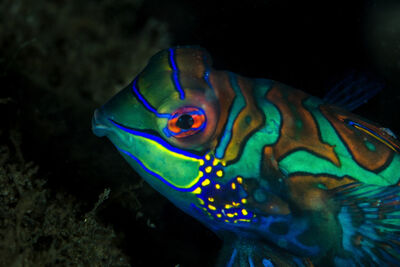
Let's kick things off with a bang - or rather, with our best buoyancy behaviour - especially when searching for the mandarin fish (an Indo-Pacific homebody found in Indonesia, the Philippines and Palau).
Small, shy and fiendishly tricky to spot, these vividly-coloured dragonets hide among coral crevices, only emerging briefly around dusk to feed and mate. Their fleeting appearance is your cue to move slowly and hover carefully...one overenthusiastic fin kick and your sought-after subject could be back among the rubble in a flash.
2. Pygmy seahorse
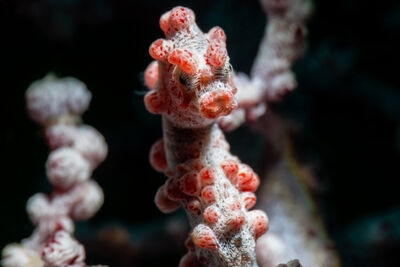
Make sure your scuba mask is thoroughly defogged before taking the plunge in pursuit of the pint-sized pygmy seahorse. Less than two centimetres long, these miniature masters of disguise are tricky enough to spot, even before their gorgonian camouflage enters the equation. Up for the challenge? Set your sights on Indonesia's Raja Ampat or Komodo or head to Japan, whose waters all harbour these teeny-tiny tenants.
And if your search proves fruitless (and has you questioning your diving prowess), fear not: pygmy seahorses even evaded scientists until 1969, when one was discovered entirely by accident.
3. Hairy shrimp
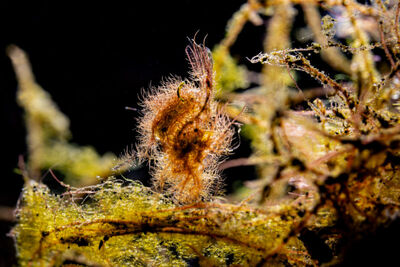
Among the ocean's most eccentric creatures is the hairy shrimp, which sports a rather questionable hairdo to match its peculiar name. Found in the Lembeh Strait and Ambon in Indonesia, as well as Anilao in the Philippines, it's hair-like filaments mimic the texture of algae - an ingenious defence mechanism.
To make matters even tricker for predators (and us divers), this crustacean is also something of a shapeshifter and can change its colouration to match its surroundings. So, on your next Indo-Pacific dive, consider every patch of algae worthy of a second squint...
4. Ghost pipefish
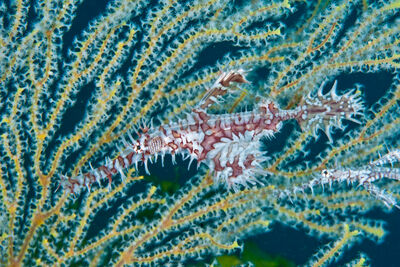
The aptly named ghost pipefish haunts the minds of divers who've scoured the ocean depths without so much as a glimpse. In true phantom form, these spiky little oddities float motionless, taking on the guise of leaves or algae. This eerie stillness allows them to lie in wait before ambushing tiny crustaceans that drift a little too close…
You can find these spectral species in Indonesia, the Philippines and Thailand. But, in keeping with every good ghost story, they tend to reveal themselves only to a lucky few...
5. Bowmouth guitarfish
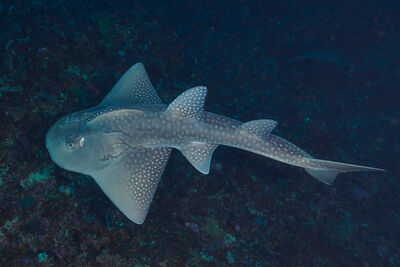
Some sightings earn a neat entry in the logbook; others warrant capital letters, several exclamation marks and an excited story back on the boat. The ultra-rare bowmouth guitarfish sits firmly in the latter category, occasionally gracing lucky divers with sightings in the Maldives, Papua New Guinea and Australia. One recently made quite the splash in Singapore, reappearing after an almost 30-year hiatus.
Sadly, fishing bycatch has contributed to its dwindling numbers, leaving the species Critically Endangered. But if the diving gods deliver, there's no mistaking their distinctive silhouette: a broad body, mighty tail and namesake bow-shaped mouth.
6. Smalltooth sawfish
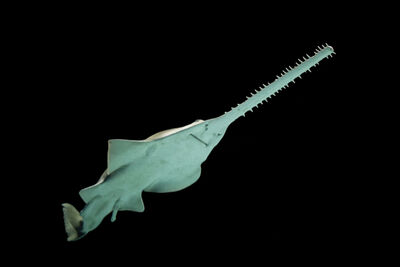
Do you have an impressive tally of ticks on your diving wish list? Then perhaps seek something a little more ambitious: the seldom-seen smalltooth sawfish. And here's a naming curveball, it actually belongs to the ray family, found in tropical waters off Florida and the Bahamas.
There's a sobering reason they're so rare, with population stats 90% down since the 1900s due to habitat loss. They're not exactly built for a baby boom either, females take a decade to mature and produce only a small brood of pups (yes, they're really called pups). They don't stay quite so cute-sounding forever, mind you. Fully grown, they sport a tooth-lined rostrum bearing an uncanny resemblance to a chainsaw - hence the name...
7. Nautilus
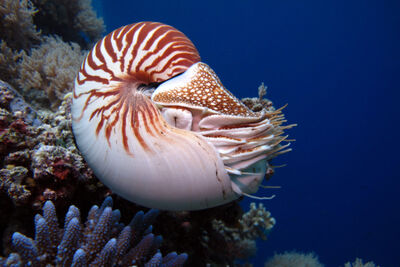
If you're lucky enough to spot a nautilus on your next dive, it's likely to spur thoughts of 'what am I looking at?'. With a 500-million-year lineage, this ultra-rare cephalopod looks part ancient fossil, part alien, with its statement spiral shell and mass of slender tentacles. Found off Indonesia, Palau and Fiji, they dwell in deeper waters by day but venture shallower after dark, giving night-owl divers the edge...
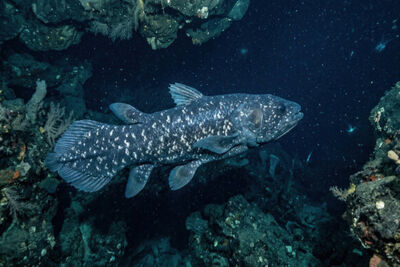
8. Coelacanth
Some marine creatures are elusive; but the coelacanth took things way further, spending millions of years known to science only through fossils. Then, in 1938, one spectacularly proved it was very much alive...
Spotting one today remains quite the feat, as these deep-dwelling fish favour underwater caverns and steep walls 150-700m deep. So, with the right technical-diving credentials under your belt, backward-roll into the waters off South Africa or Tanzania in search of this living relic.
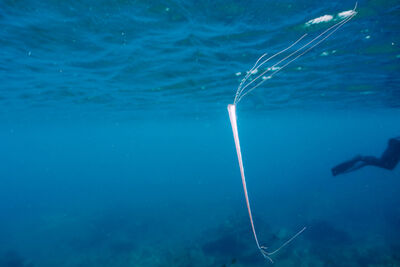
9. Oarfish
Dive buddy just fired off an emphatic flurry of hand signals during a scuba stint off Japan, Mexico or in the Mediterranean? Well, perhaps an ultra-rare oarfish has just cruised into view...
One can hardly blame the commotion. Reaching 26ft long, with a ribbon-like body and red dorsal fin, oarfish inhabit the ocean's mesopelagic zone, around 200-1,000m deep. Once in a blue moon, though, one strays unusually close to the surface, and for any recreational diver nearby, that's the equivalent of hitting the underwater jackpot.
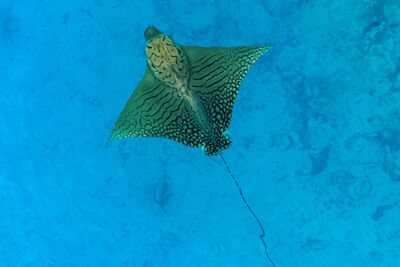
10. Ornate eagle ray
Saving the rarest until last: the ornate eagle ray, with fewer than 60 confirmed sightings worldwide. Although they're not known to frequent any particular area, their strikingly patterned backs and whip-like tails have been spotted off the Maldives, Indonesia and Mozambique.
Dubbed 'the unicorn of the sea', sightings are impossible to predict, but isn't that all part of the fun? There's always the tantalising possibility that your next dive could deliver something extraordinary...


